


ESG encompasses three main interrelated dimensions-
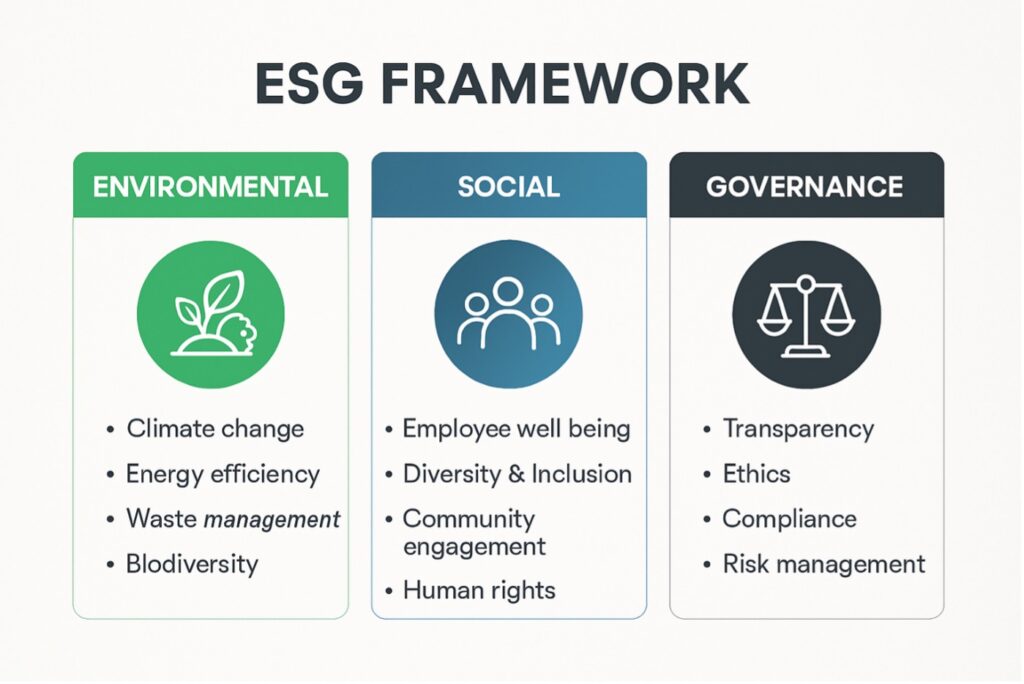
As discussions surrounding sustainability advances, the governance practices of organisations have also become a bone of contention. Aside from providing information on the traditional sustainability metrics, companies are also expected to include their governance practices in their reporting. ESG holds the holistic view that sustainability extends beyond just environmental issues. The issues of ESG have since taken centre stage in all organisations, from boardrooms to operational units, influencing strategic decisions, risk management frameworks, and stakeholder engagement practices. As investor priorities and social demands continue to evolve, the considerations of ESG are no longer optional, but are integral to the long-term value creation, corporate accountability, and sustainable growth of organizations
Organisations across sectors are increasingly aligning their governance structures, environmental policies, and social impact strategies with global sustainability standards to remain competitive and resilient in a rapidly changing landscape.
While developed countries have taken the lead in integrating sustainable practices into their business and institutions, developing countries continue to lag in their implementation and are faced with several challenges, including the following:
Financial Constraints
Most developing economies still grapple with the issue of “bread and butter”, and so the issues of sustainability may not be at the heart of policymakers and organisations.Policymakers may prioritise short-term economic growth over environmental protection or social equity, especially in resource-dependent sectors like mining, agriculture, and energy.
Socio-Economic Challenges
Developing countries often face urgent socioeconomic challenges, such as poverty, unemployment, and inadequate infrastructure, that can overshadow long-term sustainability goals. Implementing ESG standards often requires significant investment in infrastructure, compliance systems, and human capital. With limited resources, ESG risks becoming a barrier rather than a medium to inclusive development.
Institutional Weaknesses
Institutional weaknesses also pose a challenge for the adoption of ESG-related practices and reporting. Inadequate regulatory frameworks and limited enforcement capacity have the potential to undermine ESG efforts. Even where ESG regulations exist, enforcement is often inconsistent. This creates a dual challenge: businesses lack clear guidance, and investors face uncertainty about the reliability of ESG disclosures. Regardless of the institutional challenges in developing countries, Ghana made a landmark move first in 2019 and second in 2022. In 2019, the Bank of Ghana announced the decision for banks to integrate ESG practices into their business operations to promote sustainable banking through the Sustainable Banking Principles [1]. Additionally, in 2022, the Ghana Stock Exchange (GSE) launched its ESG Disclosure Guidance Manual, which requires all listed companies to adopt internationally recognised reporting standards. The manual specifically incorporates the Global Reporting Initiative (GRI) framework, positioning Ghana at the forefront of sustainable finance in Africa [2]. Apart from Ghana, other countries have also made significant strides in the wake of this new dawn.
Skills and Technical Expertise Gap
Another challenge confronting developing countries is the lack of technical expertise and know-how in the design, implementation and reporting on ESG initiatives. This gap in skills extends to regulators, auditors, and civil society actors, weakening the ecosystem needed to support ESG integration. Without targeted capacity-building efforts, ESG risks will become a compliance exercise rather than a transformative tool.
Data Deficiency
Another challenge is that the absence of reliable data makes w makes it difficult to measure progress or hold stakeholders accountable. Reliable data is the backbone of ESG reporting. Yet in many developing countries, data systems are fragmented, outdated, or absent. Environmental impact assessments may be incomplete, social indicators poorly tracked, and governance metrics inconsistently applied.This lack of data not only hampers transparency but also discourages ESG-conscious investors who rely on credible disclosures to assess risk and impact. The absence of localised ESG benchmarks further complicates efforts to tailor global standards to national contexts.
A Call to Action
These gaps highlight the need for tailored ESG models that reflect local realities rather than imposing rigid global standards. ESG can be a driver of sustainable economic growth if there’s the will and regulatory support. But to get there, support from governments and international financial institutions is essential. Governments need to develop policies that back ESG implementation, while international financial bodies can provide the necessary support for companies in developing countries.
Despite these challenges, ESG presents a powerful opportunity for transformation. By embedding ESG into development planning, countries can unlock new sources of funding, improve governance, and build resilience against environmental and social shocks. NGOs and civil society organisations play a crucial role in this process, acting as intermediaries between communities, governments, and investors. Capacity-building initiatives, such as ESG training for local officials and business leaders, can accelerate adoption. Public-private partnerships can also help scale ESG-compliant projects, particularly in sectors like renewable energy, waste management, and sustainable agriculture. Importantly, technology offers new tools for ESG monitoring and reporting, making it easier to track impact and ensure transparency.
We conclude by indicating that ESG is not a one-size-fits-all solution, but when adapted thoughtfully, it can catalyse sustainable development in the Global South. For developing countries, the challenge lies in balancing global expectations with local needs. With the right support, ESG can move beyond compliance and become a driver of inclusive growth, environmental stewardship, and ethical governance
[1] Bank of Ghana (2019). https://www.bog.gov.gh/wp-content/uploads/2019/12/Ghana-Sustainable-Banking-Principles-and-Guidelines-Book-1.pdf
[2] https://gse.com.gh/wp-content/uploads/2022/11/GSE-ESG-DISCLOSURES-GUIDANCE-MANUAL-1-1.pdf